

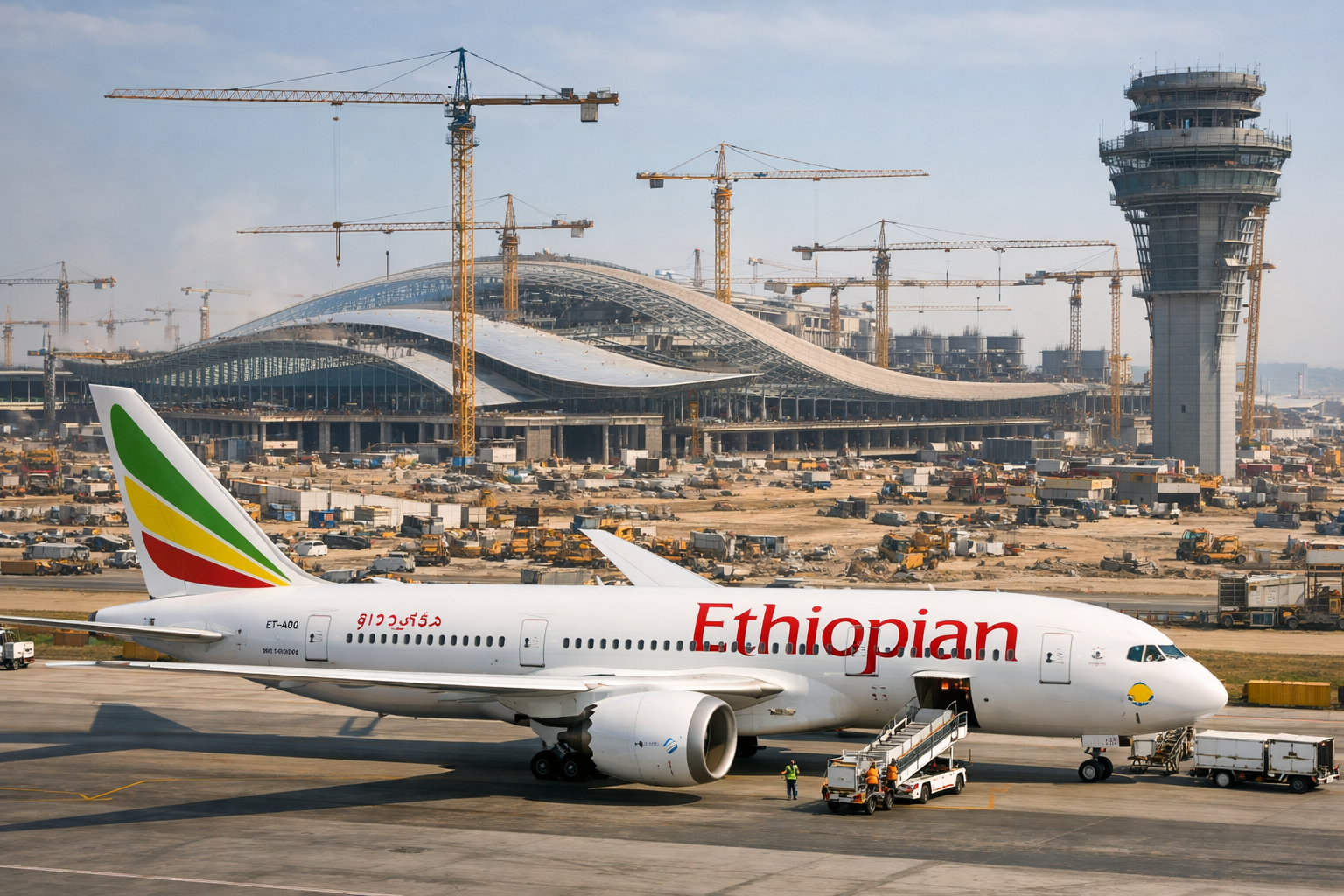
Ethiopia has embarked on a bold journey to reshape the continent’s aviation future with the launch of Bishoftu International Airport—a mega project poised to position Addis Ababa among the world’s foremost aviation hubs. The groundbreaking, held on 10 January 2026 by Ethiopian Airlines Group in partnership with the Government of Ethiopia, signals not only regional ambition but also a direct challenge to the dominance of Middle Eastern gateway airports.
Scheduled for phased completion by 2030, Bishoftu is envisioned as Africa’s largest airport and a pivotal connector in global intercontinental air traffic.
Mega Scale and Strategic Hub Ambition
The airport is being developed in stages to accommodate long-term growth in both passenger and cargo demand:
- Passenger capacity: Phase one will handle 60 million travelers annually, with full build-out reaching approximately 110 million.
- Runways and aircraft parking: Four runways and space for up to 270 aircraft will place Bishoftu on par with the world’s largest hubs.
- Airport city concept: Plans include commercial districts, advanced cargo terminals, airside hotels, and premium transit facilities—designed to maximize passenger experience and diversify revenue streams.
This scale far surpasses any existing African airport, marking a shift from incremental expansion to purpose-built global hub design far beyond any existing African airport in terms of planned throughput and operational scope.
Africa’s Current Top Five Airports: The Benchmark Bishoftu Aims to Surpass
Africa’s aviation landscape is currently anchored by a handful of major hubs:
- O.R. Tambo International Airport (Johannesburg, South Africa)
Africa’s busiest airport by passenger traffic, serving as Southern Africa’s primary gateway to Europe, the Americas, and regional markets. - Cairo International Airport (Egypt)
A strategic bridge between Africa, Europe, and the Middle East, benefitting from Egypt’s geographic position and extensive legacy-carrier operations. - Addis Ababa Bole International Airport (Ethiopia)
Currently East Africa’s leading hub and the backbone of Ethiopian Airlines’ vast intercontinental network. - Mohammed V International Airport (Casablanca, Morocco)
North and West Africa’s principal long-haul hub, leveraging Royal Air Maroc’s transatlantic and Europe–Africa connectivity. - Jomo Kenyatta International Airport (Nairobi, Kenya)
A key East African gateway with strong regional traffic and growing intercontinental reach.
While these airports play critical roles in African aviation, none were originally designed for ultra-large hub volumes exceeding 100 million passengers annually. Bishoftu’s planned capacity therefore represents a structural shift—from incremental expansion to purpose-built global hub design—setting a new benchmark for the continent.
Targeting Transcontinental Connectivity
Ethiopian Airlines, already Africa’s largest carrier, will leverage Bishoftu as the cornerstone of its Vision 2035 growth strategy, which aims to nearly double fleet size and global reach. The airport’s design assumes a high proportion of transfer passengers, mirroring the successful hub-and-spoke models of Dubai and Doha.
Planned high-speed rail links, express highways, and integrated logistics corridors will reinforce Bishoftu’s role as a continental gateway connecting Africa with the Middle East, Europe, Asia, and the Americas.
Challenging the Middle East Hubs
Global Hub Landscape
Middle Eastern airports—Dubai International (DXB), Hamad International (DOH), and Abu Dhabi International (AUH)—have long dominated global transit flows through scale, geography, and sustained investment.
| Hub Airport | Approx. Annual Capacity |
| Dubai International (DXB) | ~90–95 million |
| Hamad International (DOH) | ~40–50 million+ |
| Abu Dhabi International (AUH) | ~30–35 million+ |
| Bishoftu International (planned) | ~110 million+ |
If fully realized, Bishoftu would not only surpass all African peers but also rival or exceed the capacity of leading Middle Eastern hubs.
Strategic Comparisons
- Transit-centric model: Like DXB and DOH, Bishoftu is designed around connecting traffic.
- Geographic positioning: Ethiopia sits at the crossroads of Africa, the Middle East, and Asia, offering efficient routing for intercontinental flows.
- Cargo and logistics: Freight and logistics development are central, aligning Bishoftu with global hub economics.
Impact on Africa’s Aviation Hubs
Johannesburg – O.R. Tambo
While O.R. Tambo will remain a dominant Southern African gateway, a fully operational Bishoftu could divert long-haul transit traffic, particularly between Africa and Asia or the Middle East.
Cairo International
Cairo’s traditional advantage as a crossroads hub may face competition as airlines and passengers gain an alternative high-capacity transfer point in East Africa.
Continental Dynamics
With capacity four times greater than Bole International Airport, Bishoftu is positioned to absorb much of Africa’s future intercontinental growth, reinforcing Addis Ababa’s role as the continent’s aviation heartland and supporting broader initiatives such as the African Continental Free Trade Area (AfCFTA).
The Future of Addis Ababa Bole International Airport
As Bishoftu scales up, Bole International Airport will transition into a complementary role:
- Focus on domestic and regional operations
- Support overflow and specialized services
- Serve as a secondary hub during the transition phase
Bole’s established infrastructure and route network will continue to add resilience to Ethiopia’s aviation system.
Conclusion: A New Aviation Powerhouse
The construction of Bishoftu International Airport marks a transformative milestone for African aviation. Purpose-built at a scale unmatched on the continent, it signals Ethiopia’s intent to move from regional leadership to global hub competition.
If successful, Bishoftu could redraw intercontinental air traffic flows, challenge Middle Eastern dominance, stimulate East African economic growth, and elevate Ethiopian Airlines into the ranks of the world’s leading carriers. The ripple effects will extend from Johannesburg to Cairo—and far beyond—as global aviation networks evolve in the decades ahead.
