

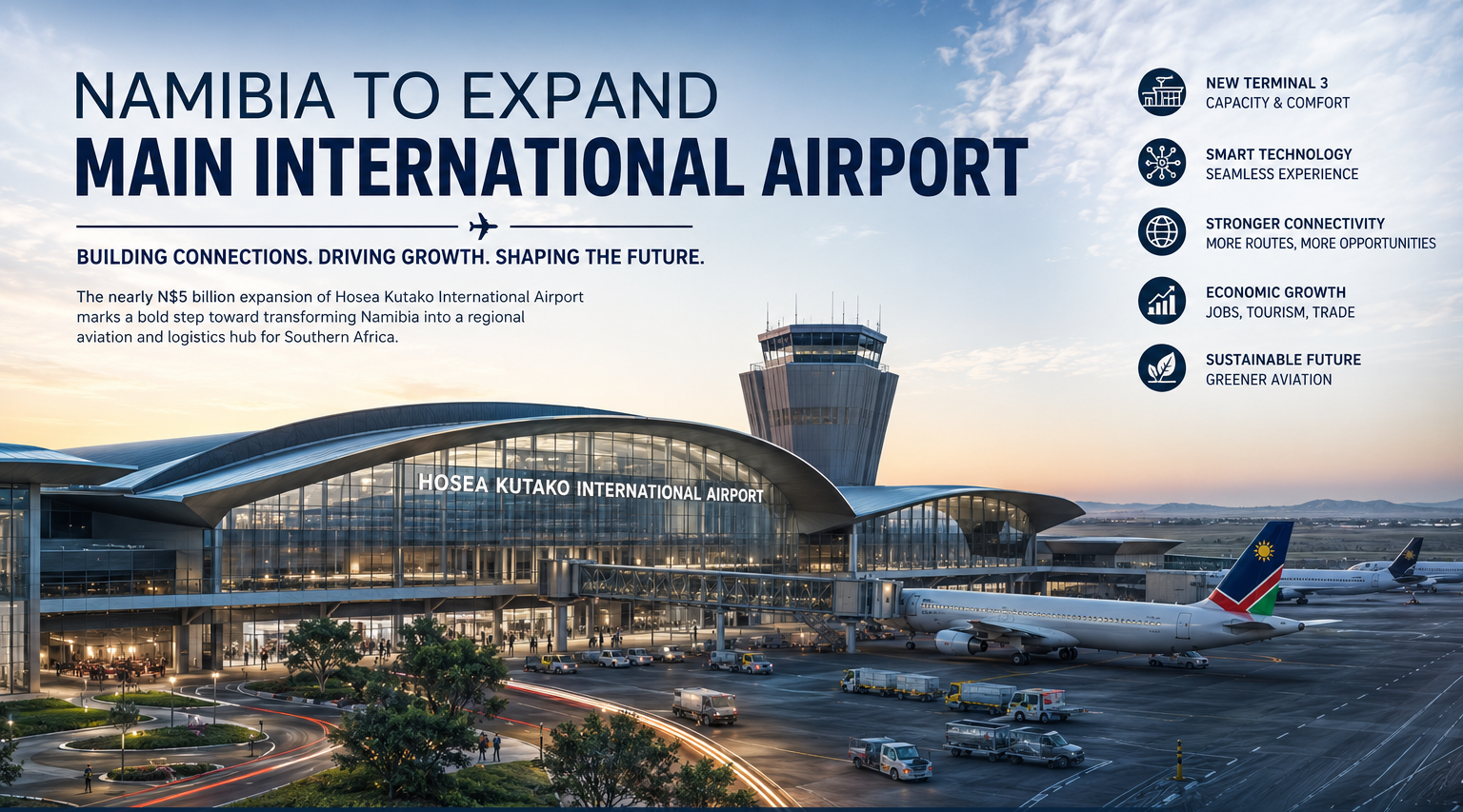
Namibia’s planned expansion of Hosea Kutako International Airport is set to become one of the country’s most significant infrastructure developments since independence. Valued at nearly N$5 billion, the Terminal 3 project is far more than an airport upgrade — it represents a long-term investment in Namibia’s economic future and regional aviation ambitions.
The development includes a new international terminal, runway upgrades, smarter airport technologies, expanded cargo facilities, and modern passenger systems. Together with planned upgrades at regional airports such as Katima Mulilo, Rundu, and Lüderitz, the project signals Namibia’s intention to strengthen its position within African and global aviation networks.
Driving Economic Growth
The expansion is expected to create major economic opportunities both during and after construction. In the short term, the project will generate jobs across construction, engineering, logistics, security, and support services. Local suppliers and SMEs could also benefit from procurement opportunities linked to the development.
Long term, improved airport capacity and connectivity could significantly boost Namibia’s tourism sector. Easier international access may encourage new airline routes, increased tourist arrivals, and greater investor confidence in hospitality and travel industries.
Cargo and logistics operations also stand to benefit. Namibia’s strategic geographic location provides strong potential as a regional trade and logistics gateway. Enhanced cargo facilities could support exports such as seafood, pharmaceuticals, fresh produce, and other high-value goods requiring rapid transportation.
Modern airports often attract surrounding economic activity, including hotels, conference centres, retail developments, logistics parks, and aviation training institutions. If managed effectively, the airport expansion could contribute meaningfully to Namibia’s broader economic diversification goals.
Social and National Impact
Beyond economics, the expansion may improve international accessibility for Namibians by creating stronger connections for education, healthcare, business, and cultural exchange. Enhanced connectivity can support greater participation in regional and global markets, particularly for younger generations entering international industries.
The project also carries symbolic value. Airports often shape first impressions of a country, and a modern international gateway can reinforce Namibia’s image as stable, investment-friendly, and globally connected.
Job creation remains one of the project’s most important social benefits. Growth in aviation could increase demand for pilots, engineers, air traffic controllers, hospitality professionals, IT specialists, and airport management personnel.
However, ensuring that local communities and Namibian businesses fully participate in the project will be critical. Sustainable development depends not only on infrastructure, but also on inclusive economic participation and skills development.
Sustainability and Environmental Responsibility
As with any major aviation project, environmental considerations remain important. Increased construction and air traffic may contribute to higher emissions, noise pollution, and environmental pressure. For a country strongly associated with conservation and eco-tourism, balancing growth with sustainability will be essential.
At the same time, the expansion creates an opportunity to adopt greener aviation infrastructure from the start. Renewable energy systems, water recycling technologies, energy-efficient designs, and sustainable airport operations could position Namibia as a regional leader in environmentally responsible aviation development.
Transforming Namibia’s Aviation Landscape
Perhaps the most significant impact will be on Namibia’s aviation sector itself. Improved infrastructure could attract additional international airlines, expand route networks, and strengthen regional connectivity. This may reduce Namibia’s reliance on larger African transit hubs and establish the country as a more competitive regional aviation gateway.
The project could also stimulate growth in aviation-related industries such as aircraft maintenance, aviation consulting, cargo handling, training academies, and digital aviation services. Combined with Namibia’s political stability and strategic location, the expansion presents an opportunity to build a broader aviation services economy.
Ultimately, the success of the project will depend not only on infrastructure investment, but also on effective policy coordination, regulatory modernization, skills development, and long-term aviation partnerships. If executed responsibly, Namibia’s airport expansion could mark the beginning of a new era in which aviation becomes a central driver of national growth and regional integration.
